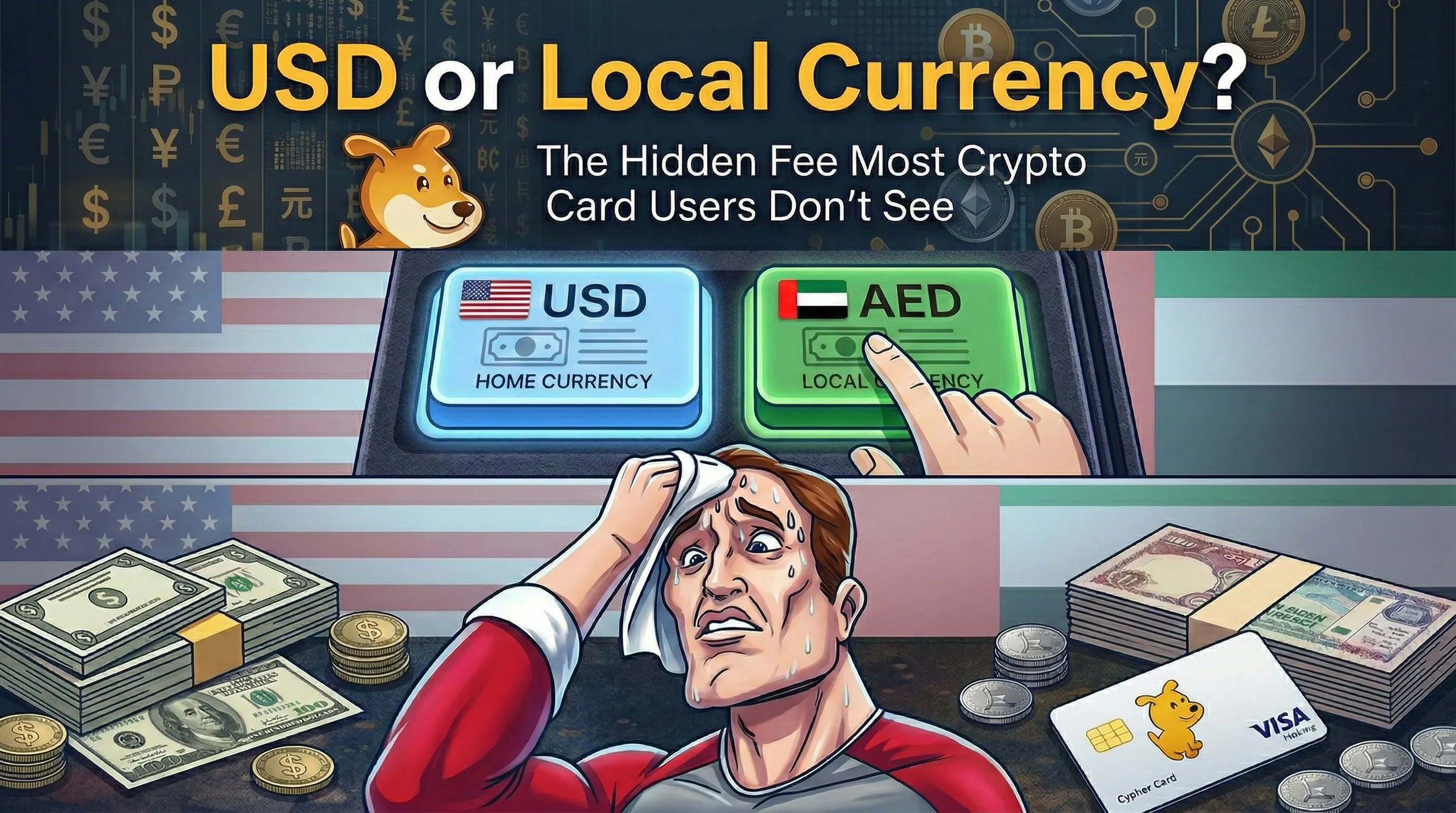

USD or Local Currency? The Checkout Choice That Can Cost You 5% to 7%
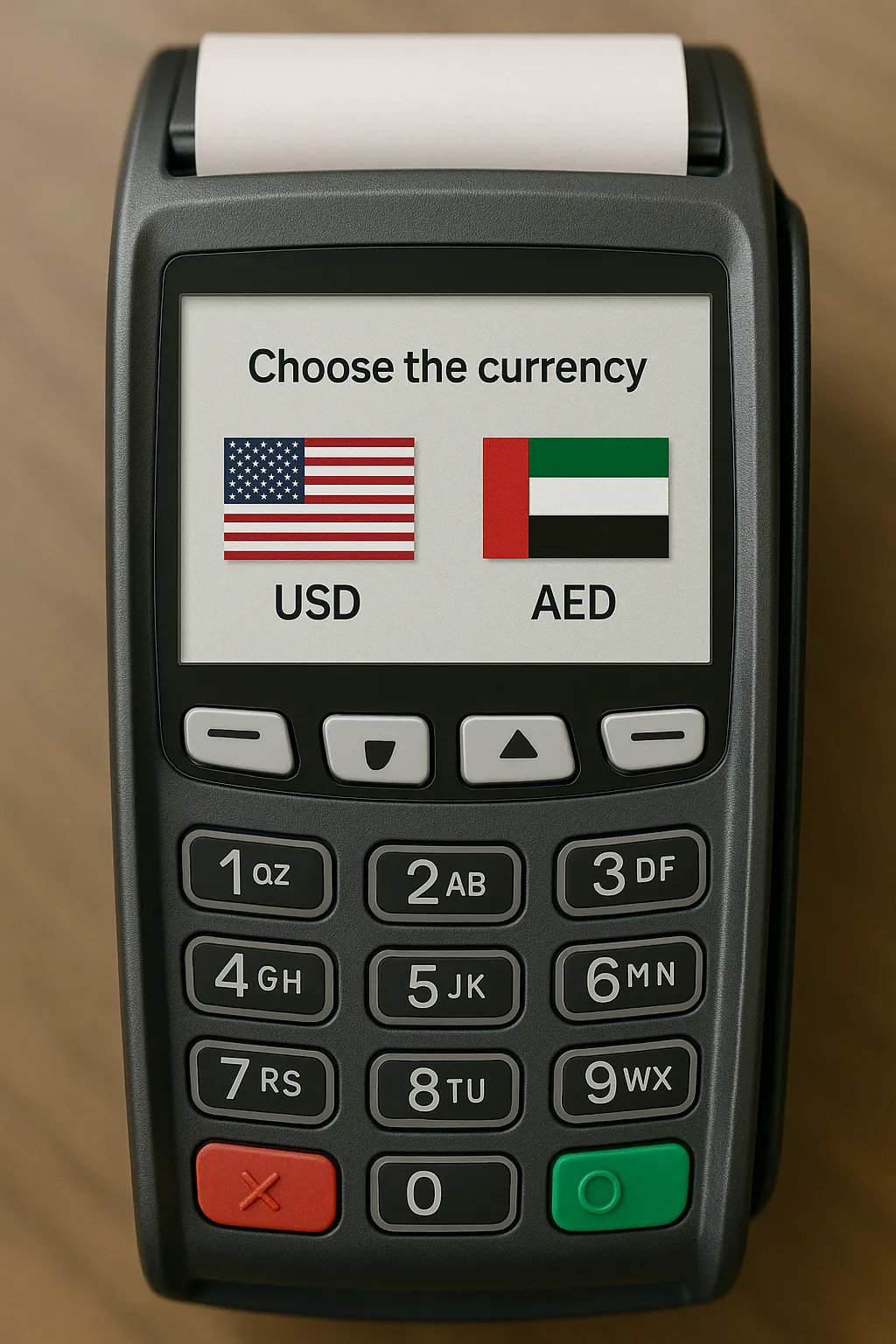
Imagine you’re at a cafe in Dubai. The POS machining shows a pop-up
Pay in USD or AED?
Most crypto card users tap USD without thinking. It feels logical. Because most of the crypto cards in the market out there is USD-denominated. So you might think paying in USD must be cheaper. Right? Not exactly.
In this guide, we’ll explain:
- What actually happens when you choose USD
- What happens when you choose local currency
- Where the hidden cost comes from
- How to avoid overpaying
By the end, you’ll know exactly which option to choose every time you see the currency selection option
When a terminal or ATM check out and online platform asks you to choose between:
- Your home currency (USD)
- The local currency (like AED)
It’s offering something called Dynamic Currency Conversion (DCC).
DCC allows the merchant or ATM to convert the transaction into USD for you on the spot. It sounds convenient. But convenience often comes at a cost.
What Happens When You Choose USD Abroad
Let’s walk through it.
You’re in the UAE. Your purchase is 100 AED.
The real Visa exchange rate might be: 1 USD = 3.67 AED So 100 AED = $27.25
But when you choose USD:
- The merchant or the ATM operator handles the conversion
- They apply their own exchange rate
- They may add a 5%-7% markup
Instead of $27.25, you might get charged: $28.80, $29.00 Or more
You won’t see a “5% fee” line item. It’s hidden inside the rate.
This is merchant-side markup. And once it happens, your card issuer usually cannot reverse it.
Your statement looks normal. But you paid more.
What Happens When You Choose Local Currency Instead
Now let’s look at the alternative.
When you choose AED:
- The merchant charges 100 AED
- The transaction goes through Visa
- Visa converts AED to USD
- Your card issuer applies its transparent forex rate
This is usually:
- Cheaper
- Closer to market rates
- More predictable
Even if your issuer charges a small forex fee (for example 1%), it’s often still lower than the merchant’s 5% markup.
What Is a Forex Fee?
A forex fee is a small percentage your card issuer charges for converting currencies.
Example:
100 AED converts to $27.25
If your forex fee is 1%: 1% of $27.25 = $0.27 Total = $27.52
Compare that to paying $29 via merchant conversion. That’s the difference.
Why Most Crypto Card Users Choose USD
It’s psychological. Most crypto cards are USD-based.
So users assume choosing USD refers fewer conversions
But that’s not how global card networks work.
When you choose local currency:
- Visa handles conversion at network rates
- Your issuer processes settlement
When you choose USD: The merchant controls the rate. That’s the key difference.
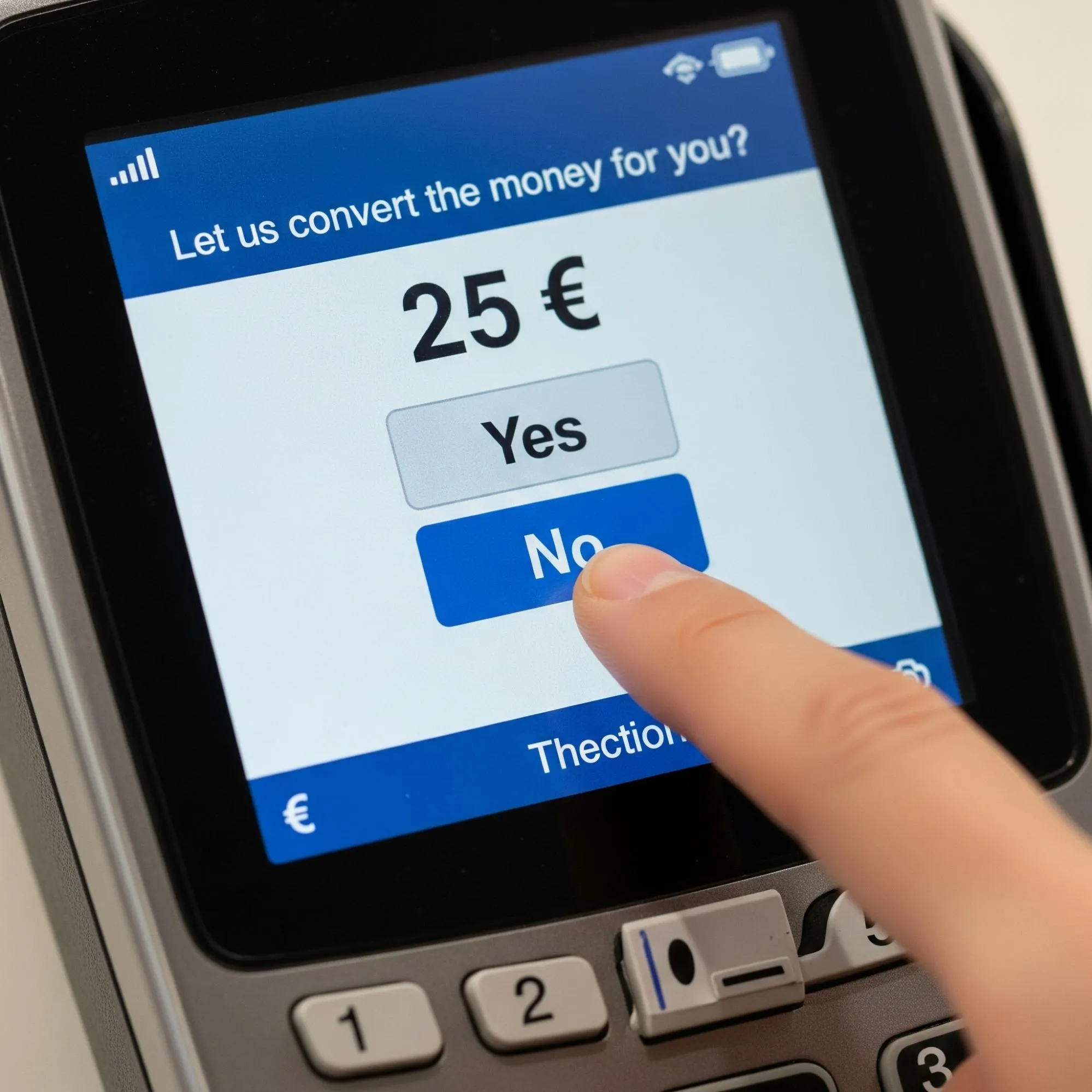
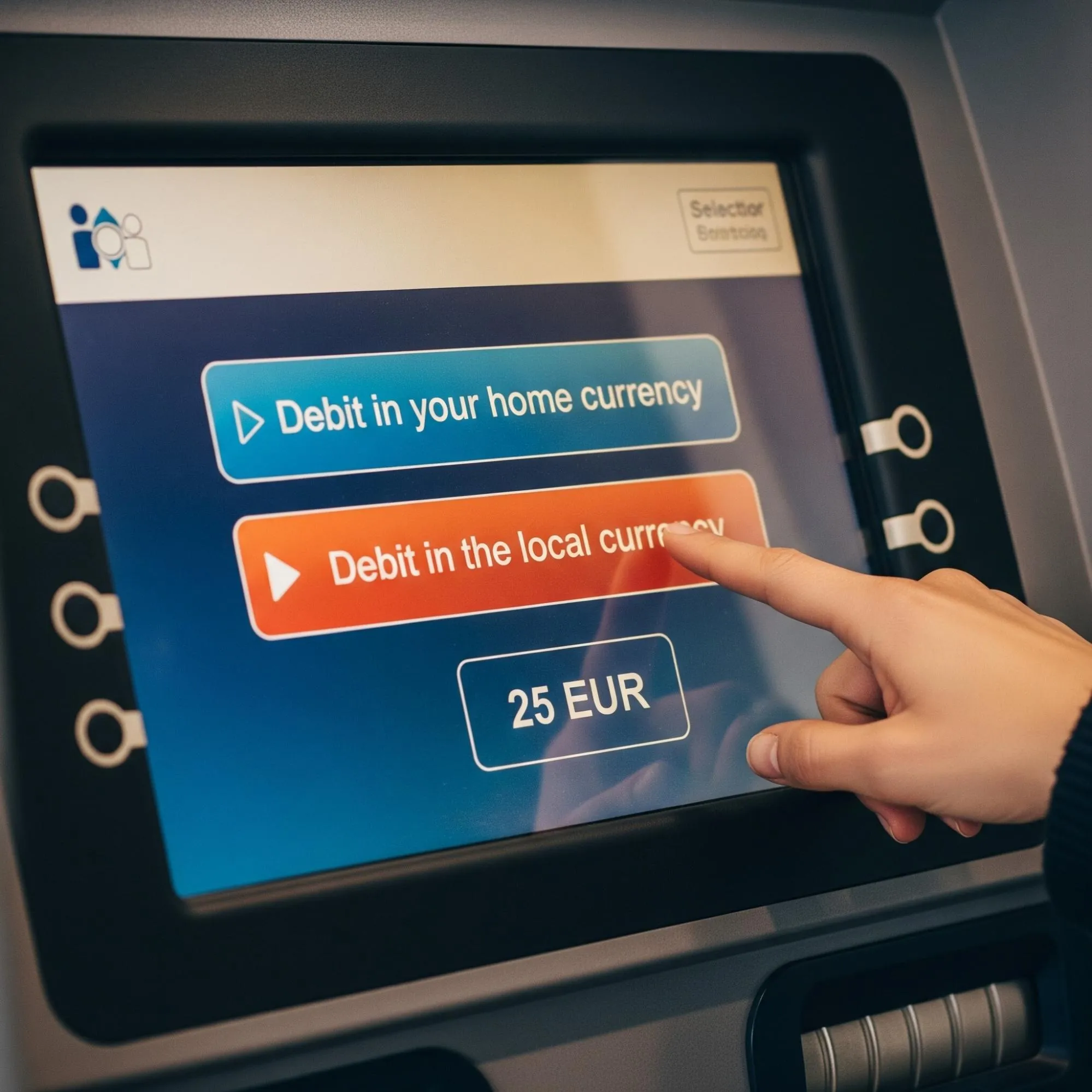
Here are some examples that might appear on the ATM or card terminal screen?
When Should You Choose USD?
Only when you are actually in the United States.
If you’re outside the US and the terminal asks: USD or Local Currency?
Always choose Local Currency.
How Cypher Protects You
At Cypher, we believe payment transparency matters.
When you choose local currency:
- We apply transparent forex rates
- No hidden merchant markups
- No surprise pricing
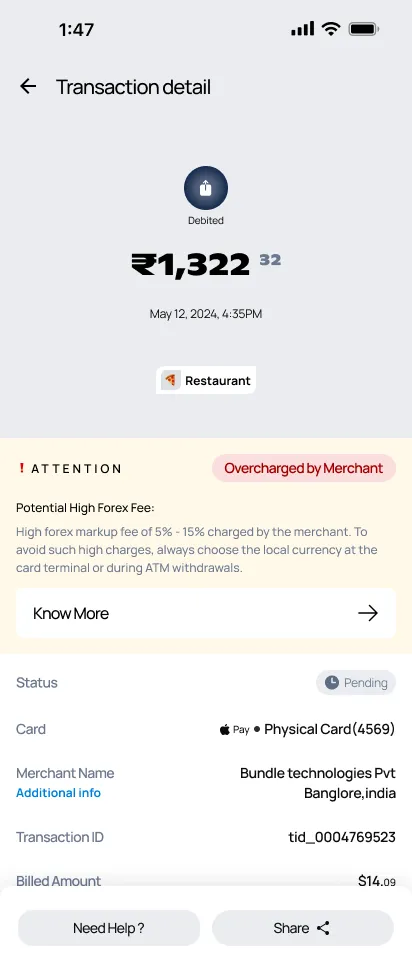
We’ve also added transaction tagging to help you identify potential DCC based overcharges.
So you stay informed. And you keep more of your money.
The Bottom Line
Dynamic Currency Conversion isn’t evil. It’s just expensive. If you’re spending abroad:
- ✓ Choose local currency
- ✓ Let Visa handle the conversion
- ✓ Let your issuer apply transparent forex
- ✓ Avoid merchant markups
One tap at checkout can cost you 5%. Now you know which one to choose.
Take Control of Your FX
With Cypher, you don’t just spend crypto. You spend smarter.
- Transparent forex rates
- No hidden markups
- Clear transaction tagging
- Full visibility into what you’re paying
Because your money should work for you, not against you.
If you travel, shop internationally, or withdraw cash abroad, this matters.
Download Cypher today and start spending globally the smarter way.